Research Area

Advancement of Multimodal Transportation Systems

Papers, project introductions, images, and links associated with this original research category.

Back to Research Areas

OD and Choice Models estimation and hypothesis tests

Joint estimation of dynamic O-D demand and choice models for dynamic multi-modal networks: computational graphs with hypothesis tests

Ma, X. and Qian, S. (Under review at Transportation Research Part C: Emerging Technologies) [Paper]
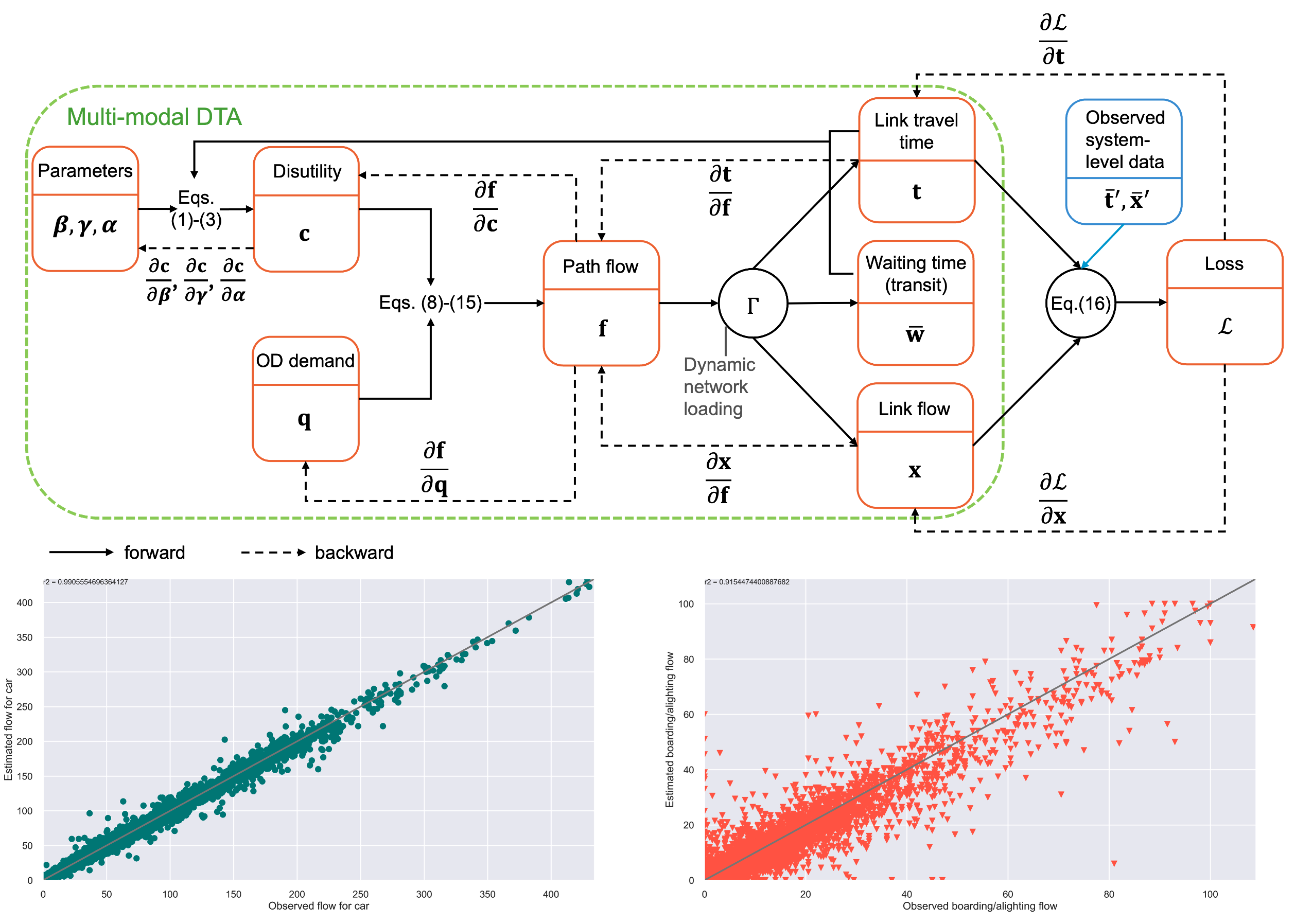
This research uses system-level data (such as traffic counts, probe speeds, and transit ridership) to infer travel choices varying by time of day, origin/destination location and mode. A joint estimation framework for dynamic origin-destination (O-D) demand and disutility functions within a multi-modal transportation system is proposed. It integrates system-level data from multiple sources into a dynamic traffic assignment model that captures both route and mode choices across car, bus, metro, and park-and-ride options. Alternative-specific and individual-specific factors are incorporated into hierarchical disutility functions to reflect heterogeneous traveler perceptions. The estimation problem is formulated and solved based on a computational graph, allowing for dynamic network modeling and scalable inference across large-scale networks and generic data sets. Furthermore, the research provides a hypothesis testing framework for analyzing statistical significance of behavioral parameters, enabling model selection and statistical insights.
Sensitivity Analysis for multi-modal O-D Estimation

Sensitivity analysis of computational graph-based dynamic multi-modal O–D estimation under data and behavioral uncertainties

Ma, X., Nardone D., Morchio M., Finan J., Sannino P., Pozza J., Neykov L., and Qian, S. (2026). Artificial Intelligence for Transportation, 7, p.100063. [Paper]

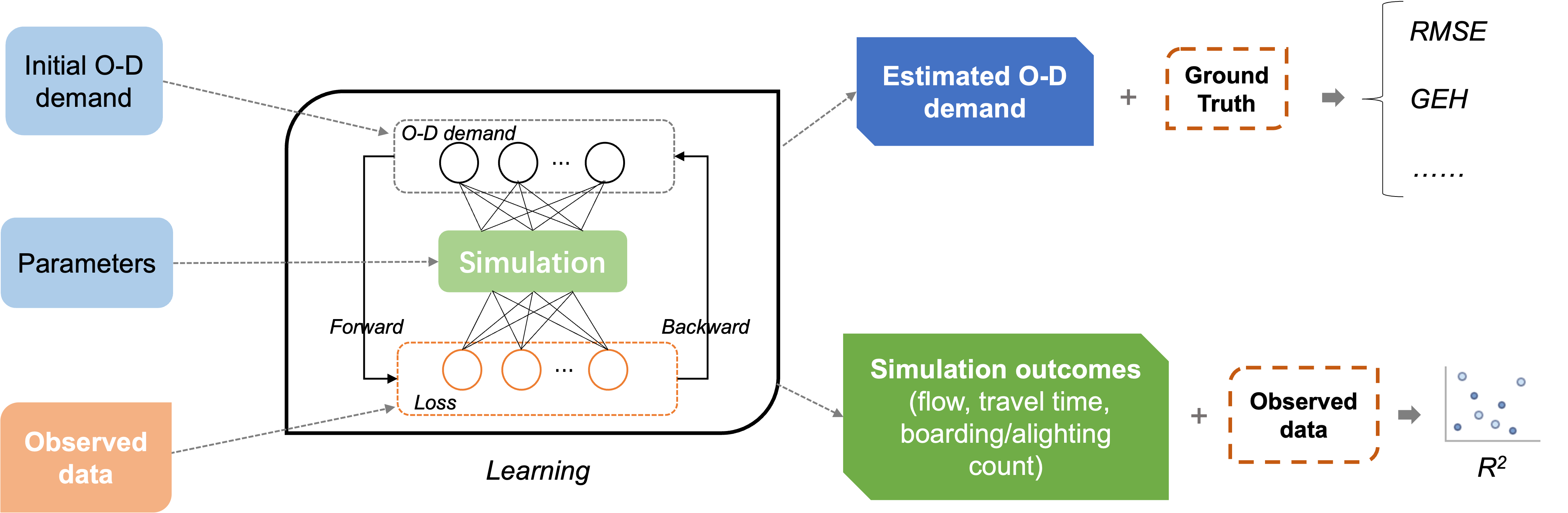
This study examines how multi-modal dynamic origin–destination estimation (DODE) is affected by uncertainties in data, modeling assumptions, and initial O–D demand. Using a computational graph-based framework, it jointly estimates dynamic demand for cars, buses, and metro by matching simulated results with observed data, such as link flows, travel times, and passenger boarding and alighting counts. The framework can flexibly integrate multiple data sources, even when coverage is incomplete, and supports sensitivity analyses of behavioral and operational factors. Results show that spatially clustered missing data have a greater negative impact than randomly missing data. Link flow data are essential for estimating car demand, while travel time data strongly affect transit estimation because of congestion interactions between modes. The estimates are relatively stable under different levels of adaptive routing but are sensitive to the initial O–D demand. Passenger count matching is also more sensitive to behavioral uncertainty than other data types. These findings emphasize the importance of integrating multi-modal data, maintaining diverse spatial coverage, and using informed initial demand estimates for reliable real-world DODE applications.