Research Area

Intelligent Traffic Information Provision for System-Level Goals

Papers, project introductions, images, and links associated with this original research category.

Back to Research Areas

CAV Routing

Providing real-time en-route suggestions to CAVs for congestion mitigation: A two-way deep reinforcement learning approach

Ma, X. and He, X., 2024. Transportation Research Part B: Methodological (ISTTT25) [Paper]
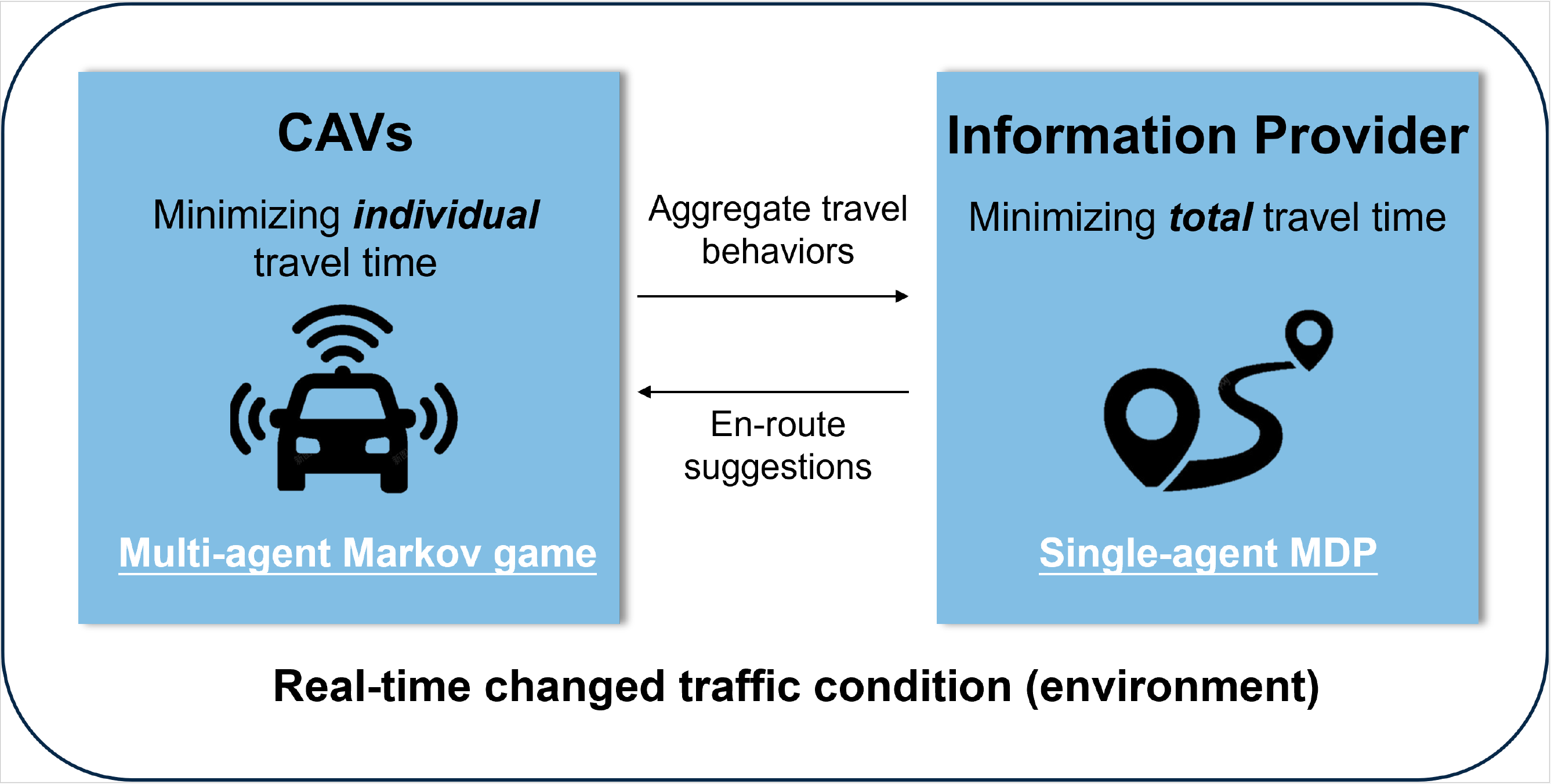
This research investigates the effectiveness of information provision for congestion reduction in Connected Autonomous Vehicle (CAV) systems. It proposes a reinforcement learning framework involving CAVs and an information provider, where CAVs conduct real-time learning to minimize their individual travel time, while the information provider offers real-time route suggestions aiming to minimize the system's total travel time. The routing problem of the CAVs is formulated as a Markov game and the information provision problem is formulated as a single-agent Markov decision process. A customized two-way deep reinforcement learning approach is developed to solve the problem. Theoretical analysis rigorously proves the realization of Correlated Equilibrium (CE) and that the proposed framework can effectively mitigate congestion without compromising individual user optimality. The results highlight the potential of information provision in fostering coordination among CAVs and achieving system-level goals in smart transportation.
Traffic Information

Multi-class within-day dynamic traffic equilibrium with simultaneous path-and-departure-time choices and strategic travel time information

Ma, X. and He, X., 2025. Transportation Research Part C: Emerging Technologies [Paper]

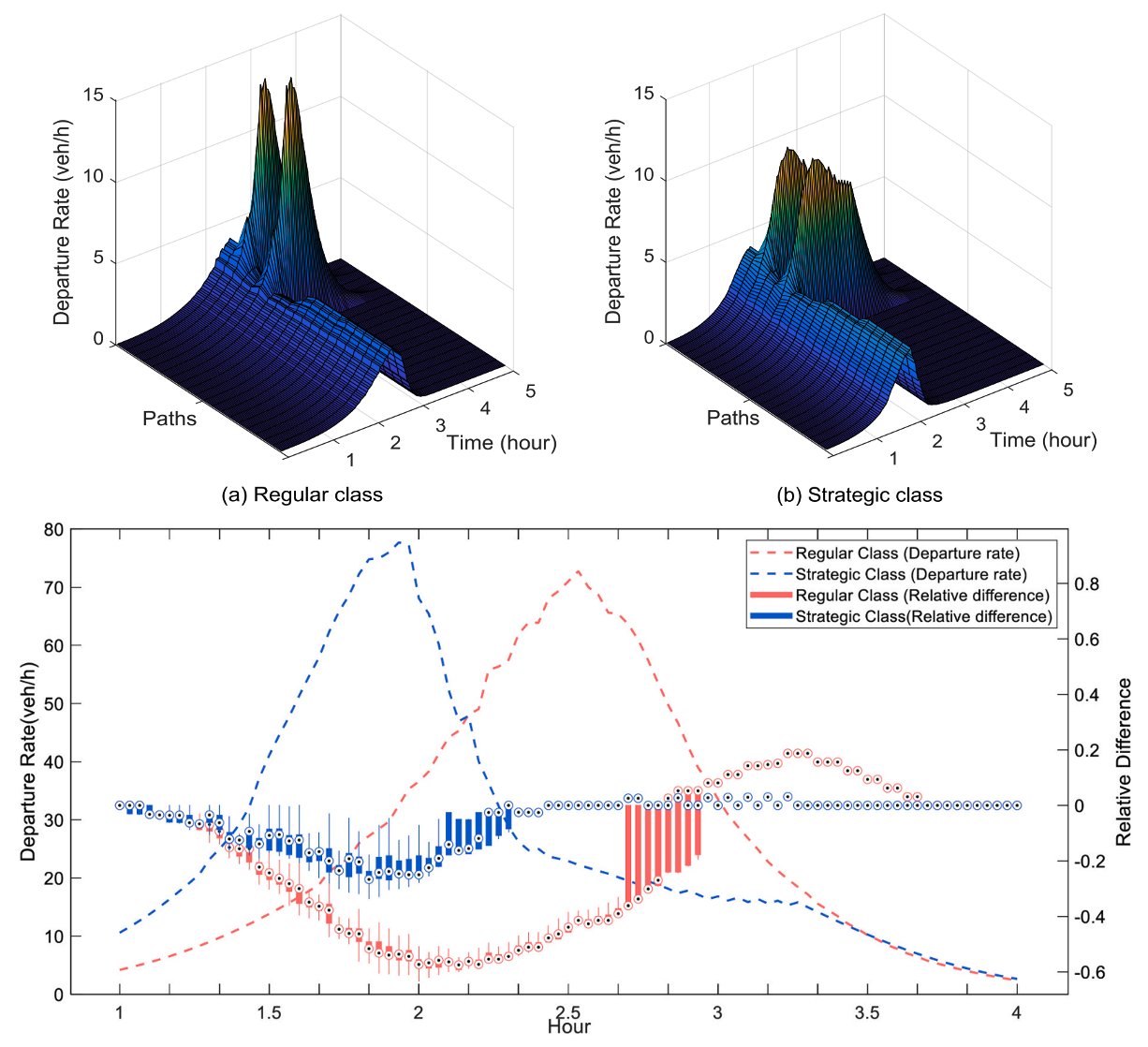
This research proposes a within-day dynamic traffic equilibrium model that explicitly formulates strategic information provision as an endogenous element. The proposed model considers travelers' reactions to the information, creating an interdependent relationship between provided information and traffic dynamics. In this framework, two classes of travelers receive different types of travel time information: one class receives instantaneous travel time reflecting the prevailing traffic conditions, while the other class receives strategic forecasts of travel times, generated by accounting for travelers' reactions to instantaneous information based on strategic thinking from behavioral game theory. The resulting multi-class within-day dynamic equilibrium differs from existing models by explicitly modeling information provision and consideration of information consistency. The theoretical propositions and numerical findings offer rich insights into the impact of information on the traffic network, strategic forecast information penetration, and information accuracy.