Research Area

Management of Long-Term Traffic Evolution

Papers, project introductions, images, and links associated with this original research category.

Back to Research Areas

Mixed Traffic with EVs

Period-to-period toll adjustment schemes for mixed traffic with time-varying electric vehicle penetration

Ma, X. and He, X., 2021. Transportation Research Part C: Emerging Technologies [Paper]
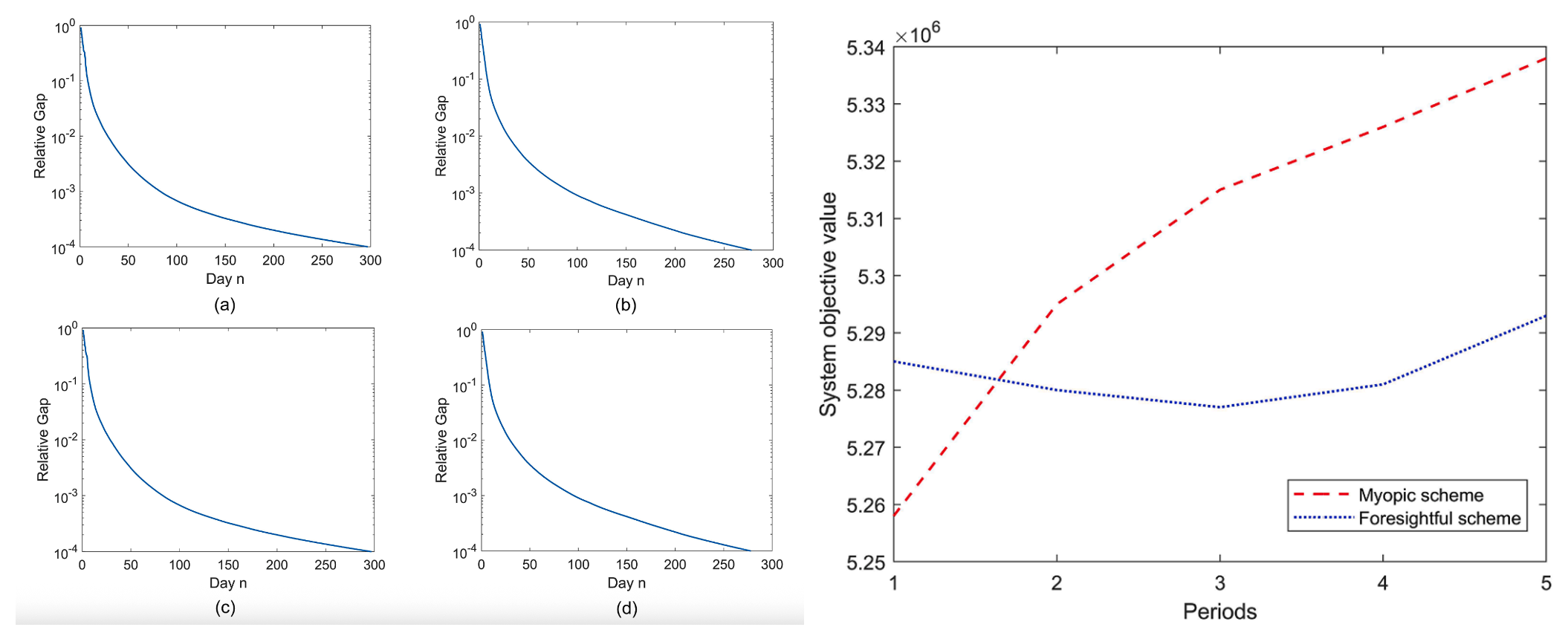
As electric vehicle (EV) penetration increases, the mixed traffic of EVs and gasoline vehicles (GVs) will be prevalent in roadway systems for a long time. Meanwhile, the periodic EV market growth will cause mixed traffic to evolve from disequilibrium to a new equilibrium. This equilibration is theoretically indeterminate due to the non-uniqueness of mixed traffic equilibria and the dynamic interaction between operational policy and underlying mixed traffic. Such indeterminacy affects the long-term mixed traffic performance that should be factored into the period-to-period adjustment of EV related policies. This research explores the properties of mixed traffic equilibria and proposes a mixed traffic evolution model considering timevarying EV penetration. The model is then integrated into a control framework to support the period-to-period adjustment of EV-promoting tolling policy for achieving long-term system-level goals.
Day-to-Day Traffic Evolution

A day-to-day dynamic evolution model and pricing scheme with bi-objective user equilibrium

Ma, X., Xu, W. and Chen, C., 2021. Transportmetrica B: Transport Dynamics [Paper]

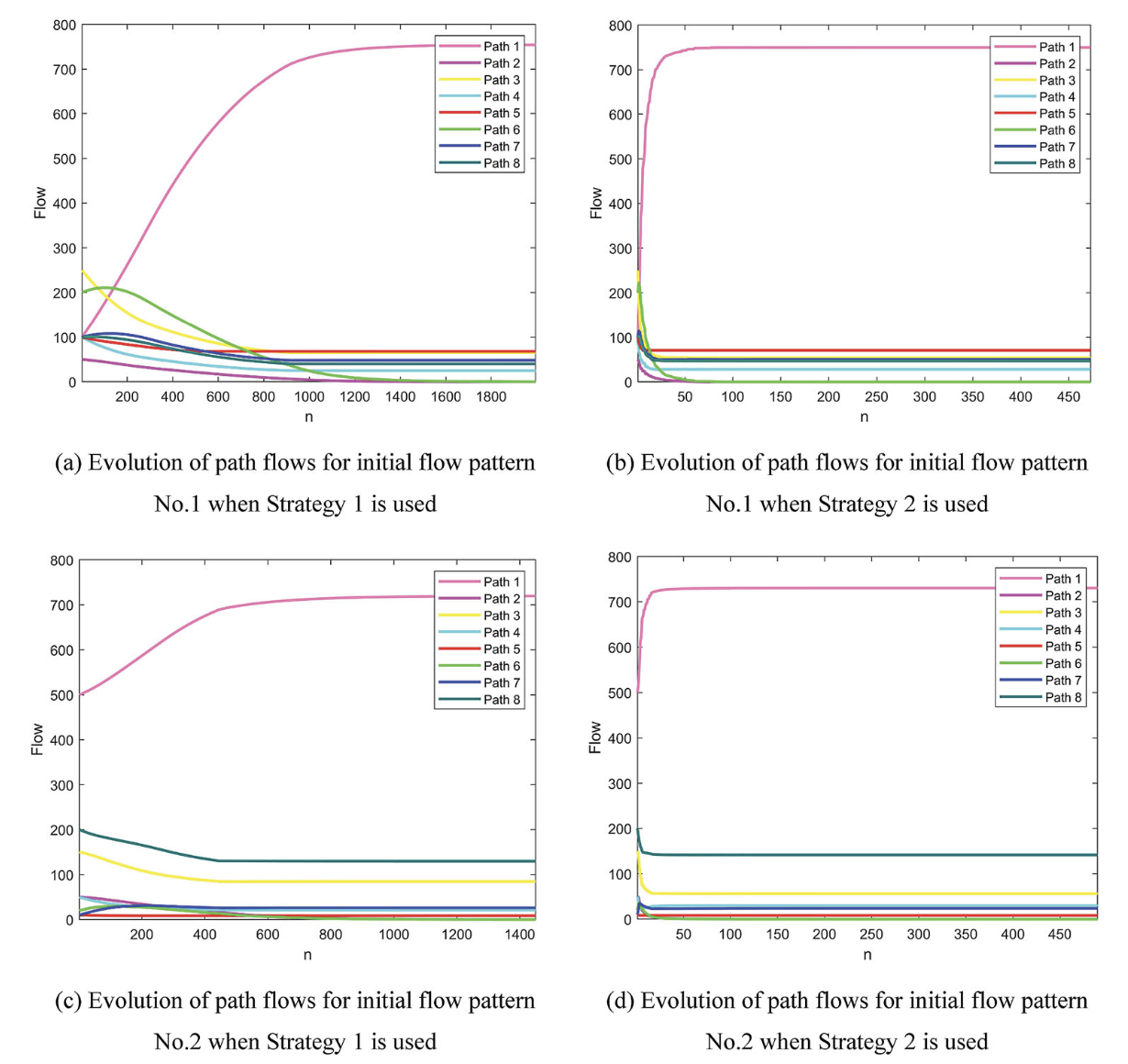
Travel time and monetary cost are the two important factors influencing travelers' route choice behavior. Rather than combining them together as a single objective, a bi-objective user equilibrium (BUE) has been proposed in which travelers consider the two objectives separately. It has been shown that BUE can explain more possible route choice results in reality. This research develops a BUE-based day-to-day dynamic model by introducing BUE into the well-known proportional-switch adjustment process (PSAP). The equivalence between the steady state of the evolution process of BUE-PSAP and a BUE state, as well as the convergence of the BUE-PSAP are proved. Moreover, a dynamic pricing scheme is proposed to reduce the system total travel time and shrink the BUE solution set containing non-unique solutions. This research contributes to the modeling of traffic evolution by providing greater explainability of real-world travel behaviors.